EIA Institute - Header Component

Implement Enterprise
Intelligence Architecture

A Structured Path from Business
Strategy to Intelligent Enterprise

Enterprise Intelligence Architecture (EIA®) provides a practical, standards-based implementation approach for organizations seeking to transform business strategy into governed intelligence. Built upon the Enterprise Intelligence Development Method (EIDM), the implementation framework combines architecture, governance, trusted data, semantic intelligence, decision intelligence, and artificial intelligence into a repeatable transformation methodology.
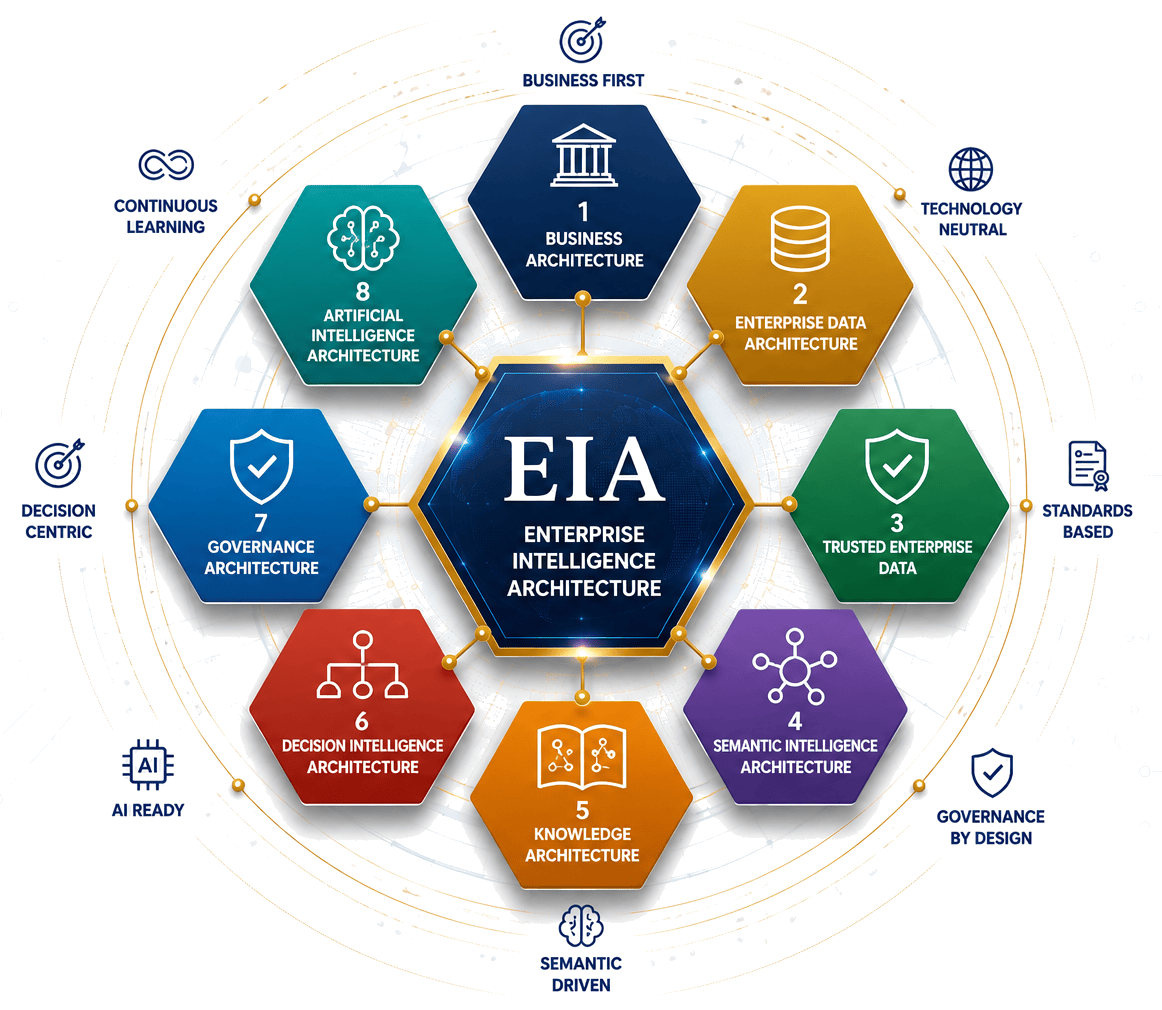
Enterprise Intelligence Architecture 8 Domains Framework

1. The EIA Implementation Philosophy

Successful enterprise transformation begins with business objectives—not technology. EIA follows a business-first approach, ensuring that every architectural decision is directly aligned with strategic goals, organizational capabilities, governance requirements, and measurable business outcomes.

Rather than implementing isolated technology solutions, organizations progressively build enterprise intelligence through governed architecture, trusted data, shared business meaning, knowledge, decision intelligence, and artificial intelligence.

2. The Enterprise Intelligence Development Method (EIDM)

100
BUSINESS VISION & STRATEGY
EIA-100 ~ EIA-199
Define strategic goals, business capabilities, value streams, and architectural vision.
200
DEVELOPMENT METHOD
EIA-200 ~ EIA-299
Guide end-to-end implementation lifecycle from assessment through architecture to continuous learning.
300
CAPABILITY ARCHITECTURE
EIA-300 ~ EIA-399
Map enterprise capabilities, organization models, and operational value streams.
400
GOVERNANCE BY DESIGN
EIA-400 ~ EIA-499
Embed governance across architecture, data, semantics, decision intelligence, and AI.
500
DATA & SEMANTIC ARCHITECTURE
EIA-500 ~ EIA-599
Build trusted data products, business glossaries, ontologies, and semantic intelligence.
600
MATURITY & ASSESSMENT
EIA-600 ~ EIA-699
Assess capability readiness, architecture maturity, conformance, and optimization.
700
PRACTITIONER GUIDANCE
EIA-700 ~ EIA-799
Provide execution templates, reference patterns, and practitioner deliverables.
800
TECHNOLOGY MAPPING
EIA-800 ~ EIA-899
Map EIA to leading platforms including Microsoft Fabric, Azure, AWS, Databricks, Snowflake, and SAP.
900
ADOPTION & CERTIFICATION
EIA-900 ~ EIA-999
Establish organizational adoption roadmaps, professional certifications, and governance excellence.

3. Implementation Roadmap

Phase 1 — Assess

Evaluate current architecture, governance maturity, data capabilities, semantic assets, and organizational readiness.

Phase 2 — Architect

Design target architecture, domain models, reference patterns, transition architecture, and governance framework.

Phase 3 — Govern

Establish governance structures, decision rights, architecture review processes, and compliance mechanisms.

Phase 4 — Implement

Build required capabilities on selected technology platforms aligned with EIA standards (Data Products, Semantics, AI).

Phase 5 — Optimize

Measure outcomes, refine architecture, monitor KPIs, and continuously improve through organizational learning.

4. Implementation Deliverables

Business Architecture & Capabilities
Target & Reference Architecture
Data Products & Information Models
Semantic Models & Glossaries
Decision Models & AI Use Cases
Governance Standards & Policies

5. Featured Deliverables

6. EIA Adoption Roadmap (Upcoming Releases)

2024
2025
2026
2027
2027+
2024
ASSESS & STRATEGIZE
  • • Current-State Assessment
  • • Stakeholder Analysis
  • • Maturity Assessment
  • • Capability Gap Analysis
2025
ARCHITECT & DESIGN
  • • Target Architecture
  • • Domain Models
  • • Reference Architecture
  • • Transition Architecture
2026
GOVERN & COMPLY
  • • Governance Model
  • • Decision Rights
  • • Architecture Review
  • • Compliance Framework
2027
IMPLEMENT & DEPLOY
  • • Trusted Data Products
  • • Semantic Models
  • • Knowledge Graphs
  • • AI & Decision Solutions
2027+
OPTIMIZE & EVOLVE
  • • KPI Monitoring
  • • Architecture Reviews
  • • Capability Enhancements
  • • Continuous Improvement

7. Implementation Accelerators

The EIA Institute provides practical assets, reference models, and professional advisory services that accelerate enterprise adoption and lower implementation risk.

  • Architecture Templates & Reference Models
  • Capability Catalogs & Maturity Assessments
  • Governance Checklists & Compliance Frameworks
  • Technology Mapping Guides (Microsoft, AWS, Databricks, Snowflake)
  • Executive Advisory & Architecture Review Services
EXPLORE IMPLEMENTATION ASSETS

8. Governance by Design

Governance is embedded throughout the implementation lifecycle,
ensuring consistency, quality, compliance, explainability, and trust.

Architecture Governance
Structured blueprints, reference models, and decision rights ensure architectural integrity.
Data Governance
Trusted data products enriched with data quality rules and compliance policies.
Semantic Governance
Standardized business glossaries, ontologies, and knowledge graphs across domains.
AI & Decision Governance
Responsible, explainable AI deployment guided by standardized decision models.

Start Your Enterprise Intelligence Journey

Whether modernizing enterprise architecture, implementing trusted data, enabling AI responsibly, or transforming decision-making, EIA provides the standards, methods, and guidance to help you succeed.