EIA Institute - Header Component
Enterprise Intelligence Architecture Standards | EIA Institute

Enterprise Intelligence
Architecture Standards

Building Intelligent Enterprises Through Open,
Structured, and Governed Standards.

The Enterprise Intelligence Architecture (EIA®) Standards establish a comprehensive body of knowledge for designing, governing, implementing, assessing, and continuously evolving intelligent enterprises.

Organized into nine standards series, the EIA Standards provide a common language, reference models, implementation methods, governance practices, technology mappings, and certification pathways that collectively define Enterprise Intelligence Architecture.
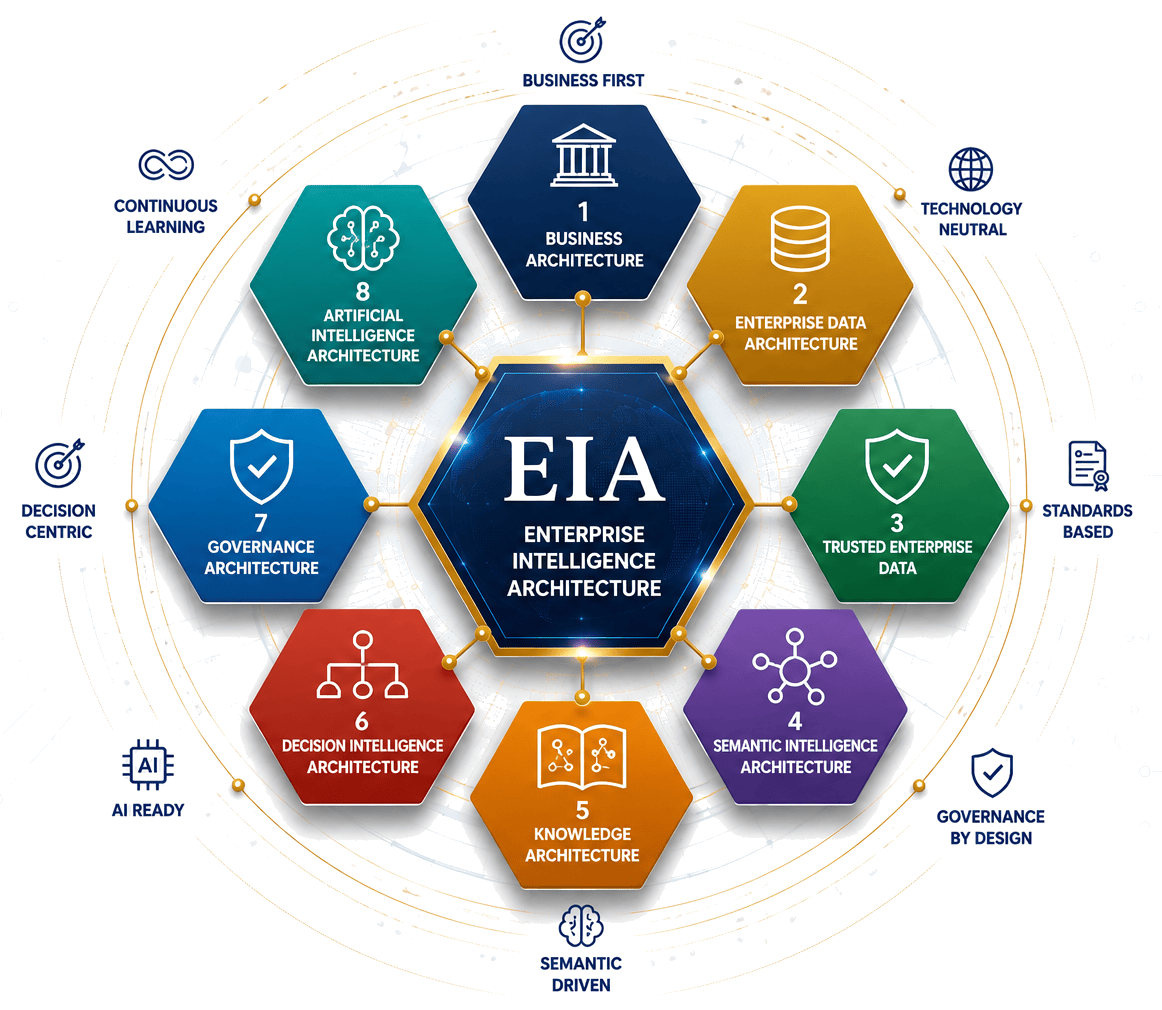
Enterprise Intelligence Architecture 8 Domains Framework

1. Why Standards Matter

Enterprise transformation succeeds when every stakeholder shares a common architectural language, follows consistent methods, and applies repeatable governance practices.

The EIA Standards provide this foundation by ensuring that architecture, data, semantics, knowledge, governance, decision intelligence, and artificial intelligence are designed using consistent principles and integrated methods.

Instead of isolated best practices, organizations gain a unified architecture framework that promotes interoperability, governance, and continuous improvement.

2. The EIA Standards Framework (Nine Standards Series)

100
FOUNDATION STANDARDS
EIA-100 ~ EIA-199
Define core concepts, vocabulary, reference architecture, meta-models, object model, viewpoints and guiding principles.
200
METHOD STANDARDS
EIA-200 ~ EIA-299
Define how EIA is developed, governed, delivered, reviewed, and continuously improved across the lifecycle.
300
CAPABILITY STANDARDS
EIA-300 ~ EIA-399
Define the architectural capabilities required to establish and operate Enterprise Intelligence Architecture.
400
GOVERNANCE STANDARDS
EIA-400 ~ EIA-499
Provide governance-by-design across business, data, semantic, decision intelligence and AI domains.
500
ASSESSMENT STANDARDS
EIA-500 ~ EIA-599
Define assessment methodologies for architecture quality, readiness, conformance and risk.
600
MATURITY STANDARDS
EIA-600 ~ EIA-699
Provide maturity models to assess enterprise intelligence capabilities across domains and capability levels.
700
PRACTITIONER STANDARDS
EIA-700 ~ EIA-799
Provide templates, deliverables, catalogs, reference patterns and practitioner guidance for implementation.
800
TECHNOLOGY MAPPING STANDARDS
EIA-800 ~ EIA-899
Map EIA to leading technology ecosystems including Microsoft, Azure, AWS, Databricks, SAP, Snowflake and Oracle.
900
CERTIFICATION STANDARDS
EIA-900 ~ EIA-999
Define certification pathways for individuals and organizations adopting EIA.

3. Standards Lifecycle

Research & Analysis
Identify industry needs, emerging
trends and research findings.
Draft Specification
Standards developed by working
groups and subject matter experts.
Working Group Review
Rigorous peer review and refinement
by expert task forces.
Public Review
Drafts published for global public
feedback and commentary.
Board Approval
Formal audit and approval by the
EIA Standards Committee.
Publication & Adoption
Officially published and made available
for enterprise adoption.
Conformance
Assessment models and practitioner
certification enablement.
Continuous Improvement
Periodically reviewed and updated
to remain cutting-edge.

4. Relationship Between Standards Series

100 Foundation Standards
200 Method Standards
300 Capability Standards
400 Governance Standards
500 Assessment Standards
600 Maturity Standards
700 Practitioner Standards
800 Technology Mapping Standards
900 Certification Standards

5. Featured Standards

6. Standards Roadmap (Upcoming Releases)

2024
2025
2026
2027
2027+
2024
FOUNDATION & METHOD
  • • EIA-100 Series
  • • EIA-110 Series
  • • EIA-120 Series (Partial)
  • • EIA-200 Series
2025
CAPABILITY & GOVERNANCE
  • • EIA-300 Series
  • • EIA-400 Series
  • • EIA-410 AI Governance
  • • EIA-420 Data Governance
2026
ASSESSMENT & MATURITY
  • • EIA-500 Series
  • • EIA-600 Series
  • • Maturity Assessment Models
  • • Conformance Framework
2027
PRACTITIONER & TECHNOLOGY
  • • EIA-700 Series
  • • EIA-800 Series
  • • Microsoft Fabric Mapping
  • • AWS & Databricks Mapping
2027+
CERTIFICATION & ECOSYSTEM
  • • EIA-900 Series
  • • Certification Programs
  • • Partner Ecosystem
  • • Global Adoption

7. Contribute to the Standards

EIA Standards are built by a global community of architects, practitioners, researchers, industry experts, and technology innovators.

You can contribute through:
  • Provide feedback on draft standards
  • Join working groups and task forces
  • Share implementation experience and case studies
  • Participate in research and validation
  • Collaborate with EIA Institute and the global community
JOIN THE STANDARDS COMMUNITY

8. Open. Structured. Governed. Global.

The EIA Standards are openly developed, transparently governed,
and globally applicable across industries and technologies.

Open & Transparent
Open development and public participation ensure trust.
Structured & Consistent
Consistent structure and numbering for easy understanding.
Governed & Reliable
Rigorous governance ensures quality and reliability.
Global & Inclusive
Designed for global adoption across industries.
Explore the EIA Standards Library
Discover the standards that define Enterprise Intelligence Architecture and guide the design of intelligent enterprises.