EIA Institute - Header Component
Enterprise Intelligence Architecture | EIA Page 2

Enterprise Intelligence Architecture

The Business-First Architecture for Intelligent Enterprises

Enterprise Intelligence Architecture (EIA®) is a business-first, technology-neutral architecture discipline that integrates business strategy, trusted data, semantic intelligence, knowledge, decision intelligence, governance, and artificial intelligence into a unified architecture.

EIA enables organizations to make trusted, explainable, and continuously improving business decisions that create measurable enterprise value.
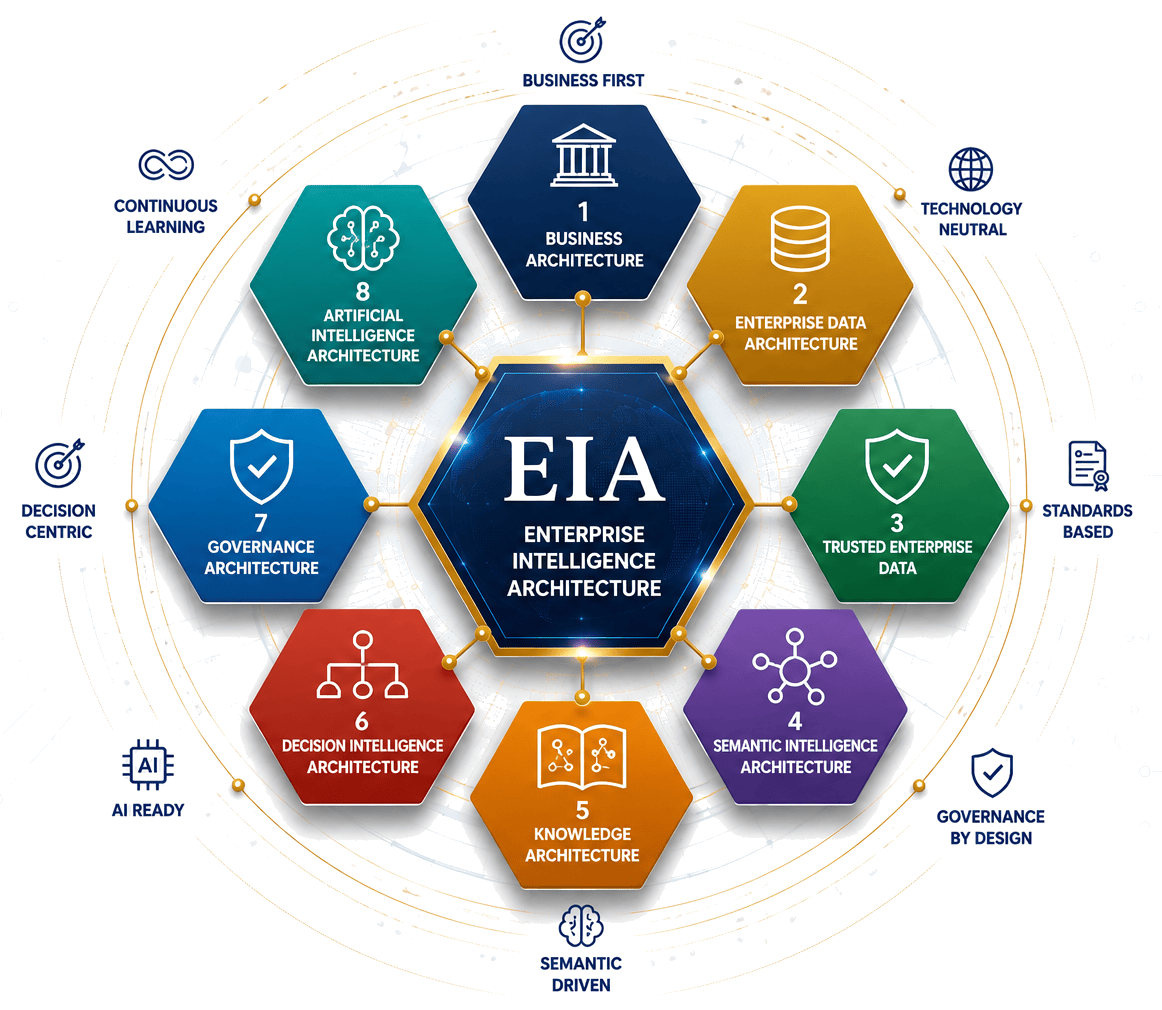
Enterprise Intelligence Architecture 8 Domains Framework

1. Why Enterprise Intelligence Architecture?

The world has moved beyond traditional Enterprise Architecture. Enterprises now require an architecture that not only aligns business and technology, but also governs data, semantics, knowledge, decisions, and artificial intelligence as interconnected disciplines.

EIA was created to unify these disciplines into a single business-first architecture so organizations can design, govern, and evolve intelligent enterprises with confidence.

Traditional Enterprise Architecture
Aligns Business and Technology
Extended with Data & Analytics
Adds Data and Analytics Capabilities
Intelligence Requirements Emerge
Need for Semantics, Knowledge, Decisions, Governance and AI
Enterprise Intelligence Architecture
EIA
Unifies Strategy, Data, Semantics, Knowledge, Decisions, Governance and AI

2. Evolution of Enterprise Architecture

Business
Architecture
Focus on strategy
and value creation
Enterprise
Architecture
Aligns business
with technology
Data
Architecture
Organizes and
manages data
as an asset
Digital
Transformation
Leverages data and
technology to transform
operations
Artificial
Intelligence
Machines augment
human intelligence
Enterprise
Intelligence
Architecture
Unifies strategy, data,
semantics, Knowledge,
decisions, governance
and AI

3. The Eight Enterprise Intelligence Domains

1   Business Architecture
Defines strategy, value streams, business capabilities, operating models and organizational structure to create enterprise value.
5   Knowledge Architecture
Organizes information into enterprise knowledge to support learning, insight generation and organizational memory.
2   Enterprise Data Architecture
Designs data strategy, information structures, data products, integration patterns and data platform capabilities.
6   Decision Intelligence Architecture
Designs decision models, rules, analytics and intelligence to enable better and faster decision-making.
3   Trusted Enterprise Data
Ensures data quality, integrity, security, lineage, privacy and lifecycle management across the enterprise.
7   Governance Architecture
Establishes governance models, policies, standards, roles, controls and compliance across all domains.
4   Semantic Intelligence Architecture
Creates shared business meaning through semantic models, ontologies, taxonomies and knowledge graphs.
8   Artificial Intelligence Architecture
Integrates ML, GenAI, intelligent agents and AI services within a governed enterprise architecture.

4. The Enterprise Intelligence Lifecycle – 14 Layers
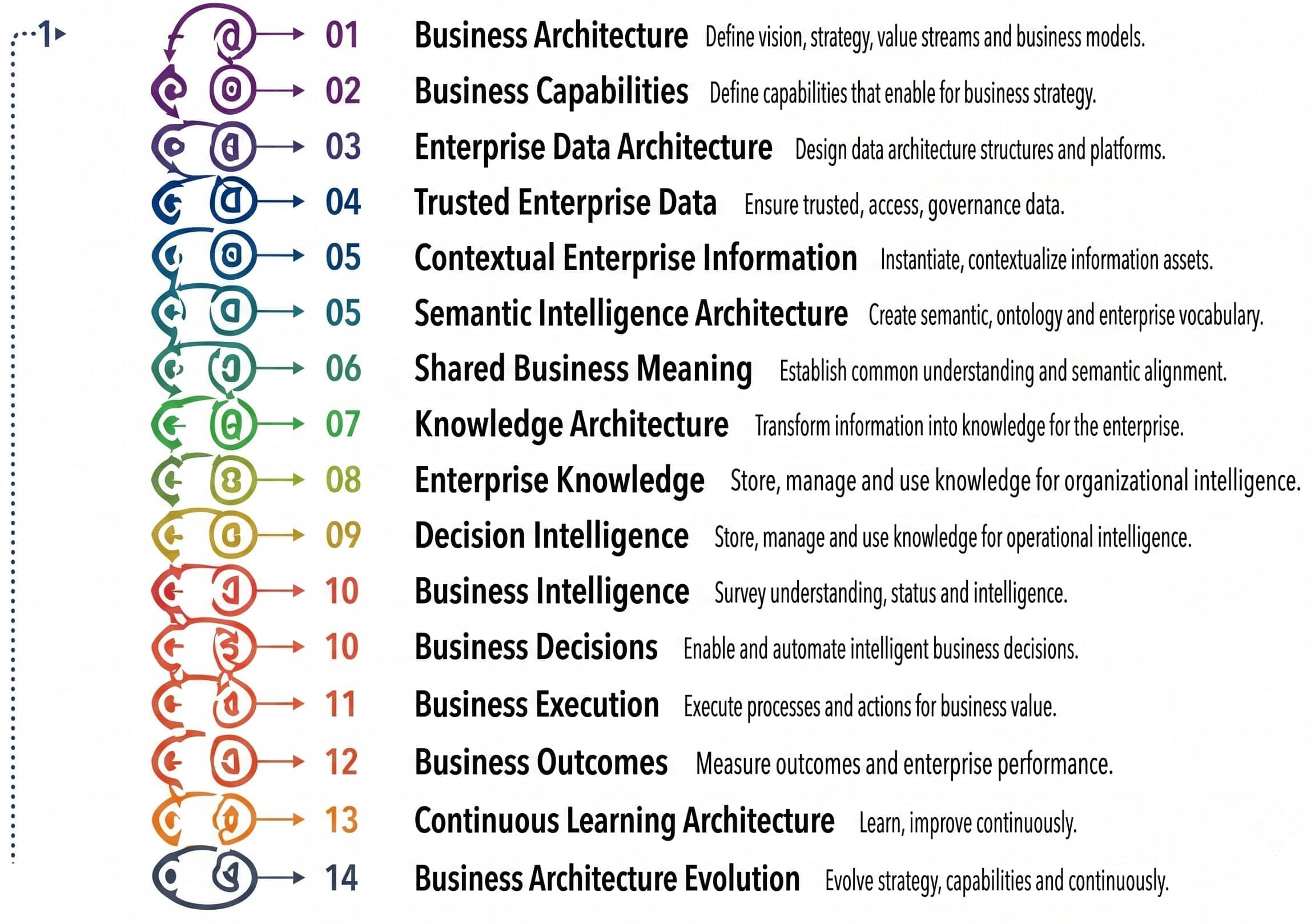
The Enterprise Intelligence Lifecycle – 14 Layers Graphic

5. Cross-Cutting Architectures

Governance Architecture
Spans Every Domain and Layer
Governance is embedded across all domains and layers to ensure compliance, accountability, risk management, policy enforcement and architecture conformance.
Cross-Cutting Architectures Graphic
Artificial Intelligence Architecture
Spans Every Domain and Layer
AI capabilities are infused across all domains and layers to augment intelligence, automate processes and enable continuous improvement.

6. EIA Meta-Model Overview

Objects
Core entities such as Capability, Data Object, Semantic Concept, Knowledge Asset, Decision, Policy and more.
Relationships
Defines how objects relate to each other across domains and layers.
Viewpoints
Multiple architectural views for business, data, semantics, applications, technology and intelligence.
Lifecycle
Defines how objects evolve from strategy to outcomes and continuous improvement.
LEARN MORE ABOUT EIA-100 CORE META-MODEL

7. Architectural Principles of EIA

Business First
Business strategy drives architecture design.
Intelligence by Design
Intelligence capabilities are intentionally architected.
Governance by Design
Governance is embedded in every decision.
Trusted Data
Trusted data is the foundation for intelligence.
Shared Meaning
Common meaning enables automation & collaboration.
Decision-Centric
Architecture exists to improve decisions.
AI Accountability
AI is governed, explainable & ethical.
Continuous Learning
Architecture evolves through feedback.

8. Relationship to Existing Frameworks

Framework Primary Focus Relationship to EIA
TOGAF® Enterprise Architecture EIA extends architectural scope into data, semantics, knowledge, decision intelligence, governance and AI.
Zachman® Classification Schema EIA can utilize classification concepts while providing lifecycle, methods and governance.
DAMA-DMBOK® Data Management EIA incorporates trusted data as one domain within broader architecture.
BABOK® Business Analysis EIA complements business analysis by providing enterprise-wide structures.
PMBOK® Project Management PMBOK governs delivery; EIA governs enterprise architecture.
EIA® Framework Business-First Intelligence Integrates strategy, data, semantics, knowledge, decisions, governance and AI.

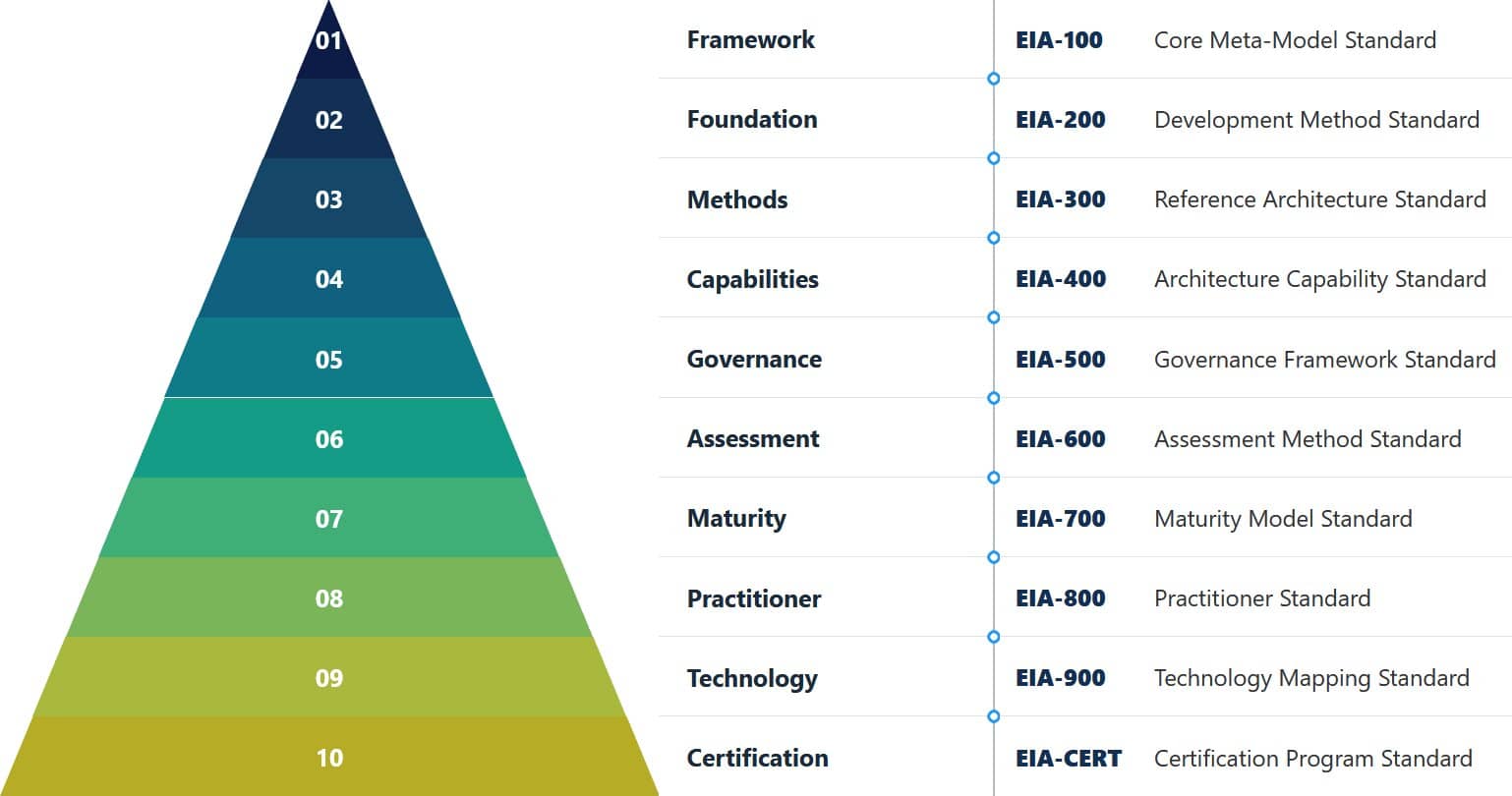
9. EIA Standards Ecosystem

EIA Standards Ecosystem Graphic
The EIA Standards provide the vocabulary, models, methods, governance, maturity and certification required to implement Enterprise Intelligence Architecture consistently across industries and technologies.
BROWSE STANDARDS
Continue Your Journey
Explore the complete EIA Standards Library to understand how each standard strengthens your enterprise intelligence architecture.
GO TO STANDARDS LIBRARY